A Complete SEO Guide for Higher Rankings, More Traffic and Long-Term Business Growth
How to Optimise Your Website for Search Engines
Every business wants to appear at the top of Google when potential customers search for products or services. However, achieving high search rankings isn’t about luck or simply adding a few keywords to your website. Search engine optimisation (SEO) is an ongoing process that improves your website’s visibility, usability, authority, and technical performance.
Modern SEO is about creating a website that serves users first. Search engines reward websites that load quickly, provide valuable information, offer a great user experience, and demonstrate expertise within their industry. As AI-powered search platforms continue to evolve, businesses must also optimise their websites for the future of search.
At Web Anatomy SEO, we help businesses build search-friendly websites that attract qualified visitors, generate leads, and support long-term growth. This guide explains the essential steps every business should take to improve its search engine performance.
Understand How Search Engines Work
Search engines use automated programs known as crawlers to discover and evaluate websites. Before your website can appear in search results, it must pass through three important stages.
Crawling
Search engines discover pages by following internal and external links. If important pages cannot be reached, they may never appear in search results.
Indexing
Once a page is discovered, search engines analyse its content and store it in their index. Pages with technical issues, duplicate content, or poor quality may not be indexed.
Ranking
When someone performs a search, Google evaluates hundreds of ranking signals to determine which pages provide the most relevant and trustworthy answers.
Understanding this process helps explain why SEO involves much more than simply publishing content.
Start with Keyword Research
Every successful SEO strategy begins with understanding what your audience is searching for.
Keyword research helps identify the words and phrases potential customers use when looking for your products or services.
Rather than targeting broad keywords with high competition, focus on search terms that closely match your business and user intent.
For example, instead of targeting “SEO,” consider more specific phrases such as:
- Technical SEO Services
- WordPress SEO
- Local SEO for Small Businesses
- SEO Company South Africa
- Website Speed Optimisation
Long-tail keywords often attract visitors who are more likely to become customers.
Create Helpful, High-Quality Content
Content remains one of Google’s strongest ranking signals.
Your website should answer the questions your customers are asking and provide useful information that demonstrates expertise.
Examples of valuable content include:
- How-to guides
- Industry insights
- Service pages
- Frequently asked questions
- Case studies
- Buying guides
- Tutorials
- Blog articles
Every page should focus on a single topic and provide clear, accurate, and helpful information.
Publishing consistent, high-quality content builds authority over time.
Optimise Every Page
Every page on your website should be properly optimised.
Page Titles
Create unique titles that include your primary keyword while encouraging users to click.
Meta Descriptions
Write concise descriptions that summarise the page and improve click-through rates.
Heading Structure
Use one H1 heading followed by logical H2 and H3 headings.
URLs
Keep URLs short, descriptive, and keyword-focused.
Example:
yourwebsite.co.za/technical-seo-services
Avoid long URLs containing unnecessary numbers or parameters.
Images
Optimise images by:
- Compressing file sizes
- Using WebP images
- Adding descriptive filenames
- Including alt text
Image optimisation improves both SEO and website performance.
Improve Your Technical SEO
Technical SEO ensures search engines can crawl, understand, and index your website effectively.
Important areas include:
- HTTPS security
- XML sitemaps
- Robots.txt
- Canonical tags
- Internal linking
- Structured data
- Clean URL structures
- Redirect management
- Crawl error monitoring
Without strong Technical SEO, even excellent content may struggle to rank.
Increase Website Speed
Website speed directly affects both rankings and user experience.
Visitors expect pages to load within a few seconds, and slow websites often experience higher bounce rates and lower conversion rates.
Improve website speed by:
- Compressing images
- Using browser caching
- Optimising CSS and JavaScript
- Enabling lazy loading
- Choosing quality hosting
- Using a Content Delivery Network (CDN)
- Cleaning your WordPress database
Google’s Core Web Vitals also place significant emphasis on website performance.
Understand Core Web Vitals
Core Web Vitals measure how users experience your website.
The three metrics include:
Largest Contentful Paint (LCP)
Measures loading performance.
Target: Under 2.5 seconds.
Interaction to Next Paint (INP)
Measures responsiveness.
Target: Under 200 milliseconds.
Cumulative Layout Shift (CLS)
Measures visual stability.
Target: Below 0.1.
Improving these metrics benefits both SEO and visitor satisfaction.
Make Your Website Mobile-Friendly
Most website traffic now comes from smartphones and tablets.
Google primarily indexes the mobile version of your website, making mobile optimisation essential.
Your website should:
- Display correctly on all devices
- Load quickly
- Use readable text
- Provide simple navigation
- Have touch-friendly buttons
- Offer easy-to-complete forms
A positive mobile experience helps improve both rankings and conversions.
Build Strong Internal Links
Internal links help visitors discover related content while allowing search engines to understand the structure of your website.
A strong internal linking strategy:
- Connects related articles
- Strengthens service pages
- Distributes authority
- Improves crawlability
- Supports topic clusters
Every important page should link naturally to other relevant pages within your website.
Build Authority Through Content
Google rewards websites that demonstrate expertise.
Publishing useful resources consistently helps establish your business as a trusted authority.
Examples include:
- Complete guides
- Industry news
- Tutorials
- Research
- Customer success stories
- Frequently asked questions
Authority is built gradually through helpful, original content.
Optimise for Local SEO
If your business serves customers within a specific area, Local SEO should be a priority.
Improve local visibility by:
- Optimising your Google Business Profile
- Creating location pages
- Collecting customer reviews
- Maintaining consistent business information
- Publishing local content
Local SEO helps businesses appear in both Google Search and Google Maps.
Prepare for AI Search
Search behaviour continues to evolve.
People increasingly ask AI assistants questions instead of typing short search queries.
To improve visibility in AI-powered search:
- Create comprehensive content
- Answer customer questions clearly
- Implement structured data
- Build topic clusters
- Demonstrate expertise
- Keep information current
A technically strong website with helpful content is more likely to be referenced by AI-powered search systems.
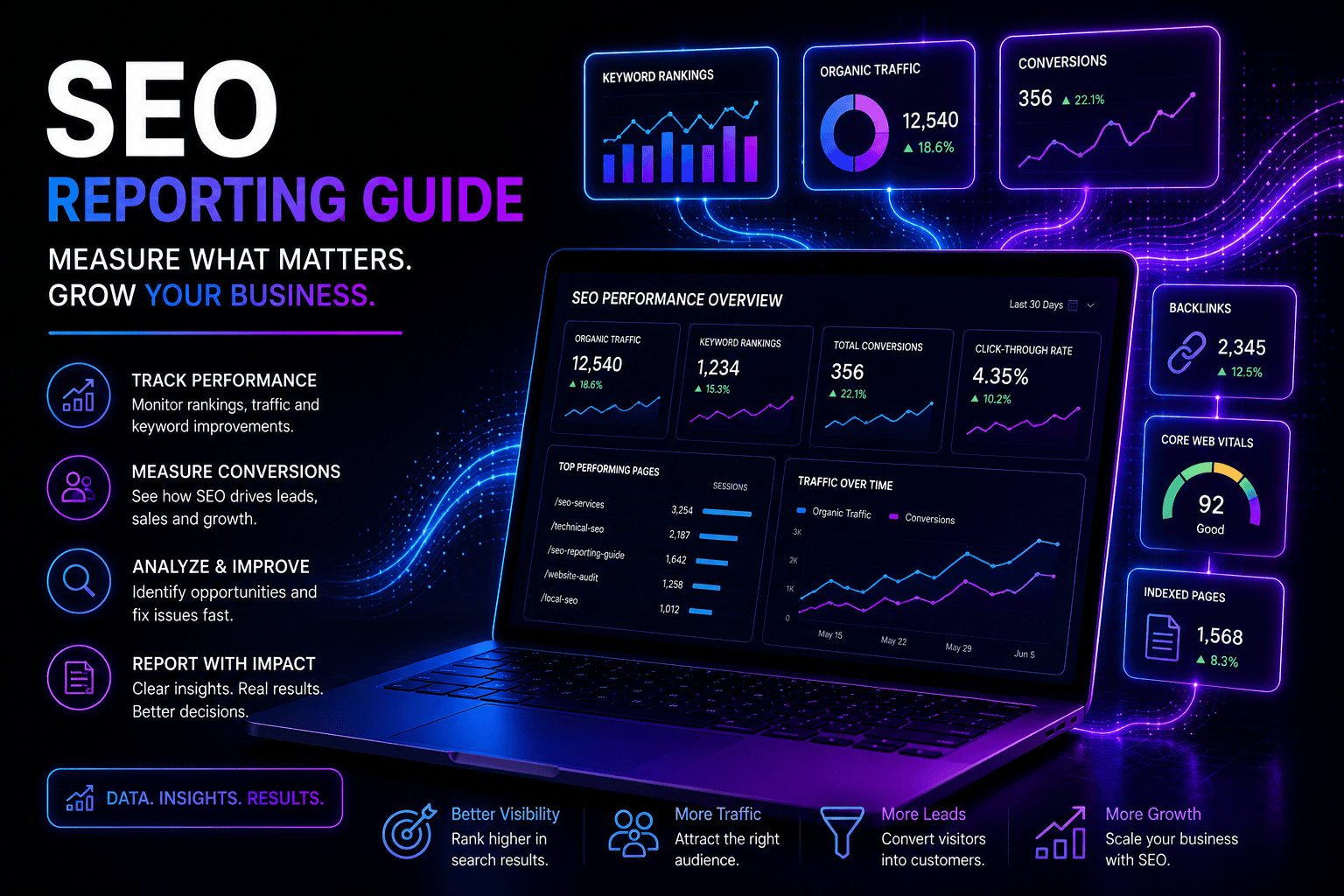
Monitor Your SEO Performance
SEO should be monitored continuously.
Important metrics include:
- Organic traffic
- Keyword rankings
- Search impressions
- Click-through rate
- Core Web Vitals
- Indexing status
- Conversion rate
- Bounce rate
Regular reviews help identify opportunities for improvement.
Common SEO Mistakes
Many businesses unknowingly limit their search visibility by making avoidable mistakes.
Common issues include:
- Slow-loading pages
- Poor mobile usability
- Duplicate content
- Missing metadata
- Weak internal linking
- Outdated content
- Broken links
- Ignoring Technical SEO
- Poor image optimisation
- Inconsistent business information
Regular website audits help identify and resolve these problems.
Why SEO Is a Long-Term Investment
Unlike paid advertising, SEO continues delivering value long after individual improvements are made.
Every optimised page becomes another opportunity for customers to discover your business.
Over time, your website gains:
- More authority
- Better rankings
- Increased organic traffic
- Greater customer trust
- Lower customer acquisition costs
Businesses that invest consistently in SEO build sustainable online growth rather than relying solely on paid advertising.
How Web Anatomy SEO Can Help
At Web Anatomy SEO, we help businesses improve every aspect of their online presence through:
- Technical SEO Audits
- WordPress SEO
- AI Search Optimisation
- Local SEO
- Google Business Profile Optimisation
- Website Speed Optimisation
- Core Web Vitals Improvements
- Content Strategy
- Managed WordPress Hosting
- Monthly SEO Management
Our goal is to help your business attract more qualified visitors, generate more leads, and achieve measurable long-term growth.
Final Thoughts
Optimising your website for search engines is not about shortcuts or chasing algorithms. It is about creating a fast, secure, informative, and user-friendly website that genuinely helps your audience.
By combining high-quality content, technical excellence, mobile optimisation, strong internal linking, and ongoing performance monitoring, you build a website that earns visibility in both traditional search engines and AI-powered search experiences.
SEO is an ongoing investment, but the businesses that commit to it consistently outperform competitors over the long term.
Frequently Asked Questions
How long does SEO take to work?
Most websites begin seeing measurable improvements within three to six months, depending on competition and the current state of the website.
Is SEO better than Google Ads?
SEO provides long-term organic growth, while Google Ads delivers immediate visibility. A combination of both often produces the best results.
Does website speed affect rankings?
Yes. Fast websites provide a better user experience and support stronger search performance.
Why is Technical SEO important?
Technical SEO helps search engines crawl, understand, and index your website efficiently while improving website performance.
What are Core Web Vitals?
Core Web Vitals measure loading speed, responsiveness, and visual stability to evaluate user experience.
How often should I update my website?
Review important pages regularly and publish fresh, relevant content consistently to maintain search visibility.
Can AI search affect my SEO strategy?
Yes. AI-powered search increasingly rewards websites with structured, authoritative, and helpful content supported by strong Technical SEO.
Why choose Web Anatomy SEO?
Web Anatomy SEO combines Technical SEO, WordPress optimisation, AI Search Optimisation, Local SEO, website performance improvements, and ongoing SEO management to help businesses achieve sustainable online growth.