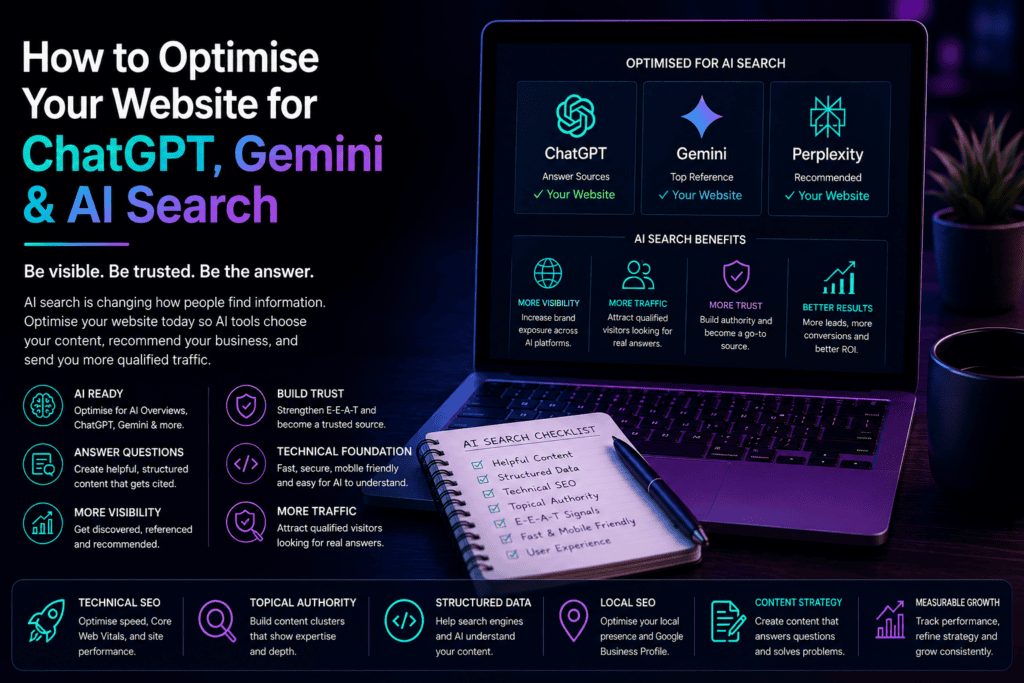
How to Optimise Your Website for ChatGPT, Gemini & AI Search
For over two decades, businesses have optimised their websites to rank on traditional search engines like Google and Bing. Today, search is evolving faster than ever.
Instead of scrolling through pages of search results, people are increasingly asking AI-powered assistants questions and receiving direct answers. Platforms like ChatGPT, Google AI Overviews, Gemini, Microsoft Copilot, and Perplexity are changing how users discover information, compare services, and make purchasing decisions.
This shift means that traditional SEO alone is no longer enough. Businesses must now optimise for AI-powered search experiences as well.
At Web Anatomy SEO, we help businesses prepare for the future of search by combining technical SEO, high-quality content, structured data, and Answer Engine Optimisation (AEO) to improve visibility across both search engines and AI platforms.
What Is AI Search?
AI search uses large language models (LLMs) and advanced search technologies to answer questions directly instead of simply displaying a list of websites.
Rather than typing:
“Best SEO company South Africa”
People now ask:
- Who is the best SEO agency for WordPress?
- How do I improve my Google rankings?
- Why is my website losing traffic?
- What is the difference between SEO and Google Ads?
AI systems analyse trusted sources, identify the most relevant information, and generate clear answers.
If your website consistently provides helpful, well-structured, and authoritative content, it has a much better chance of being referenced.
Why AI Search Matters
Millions of people now use AI assistants every day to research products, compare businesses, solve problems, and make purchasing decisions.
Businesses that adapt early can benefit from:
- Greater online visibility
- Increased brand authority
- More qualified traffic
- Better trust signals
- Future-proof digital marketing
The businesses that ignore AI search may gradually lose visibility as user behaviour continues to evolve.
Traditional SEO Is Still the Foundation
One of the biggest misconceptions is that AI Search has replaced SEO.
It hasn’t.
AI platforms still rely heavily on the same signals that make websites successful in Google Search.
These include:
- Technical SEO
- Helpful content
- Website authority
- Mobile optimisation
- Fast loading speeds
- Internal linking
- Structured data
- User experience
Think of AI optimisation as an extension of SEO—not a replacement.
Create Content That Answers Questions
AI assistants favour content that clearly answers specific questions.
Instead of creating pages that simply target keywords, create content that genuinely helps users.
Examples include:
- How-to guides
- Step-by-step tutorials
- Buying guides
- Comparisons
- FAQs
- Checklists
- Industry insights
- Case studies
Every page should solve a real problem.
The more useful your content is, the more likely AI systems are to reference it.
Build Topical Authority
Publishing one great article isn’t enough.
AI platforms look for websites that demonstrate deep expertise across an entire subject.
Instead of writing one article about SEO, build a complete knowledge hub.
For example:
Technical SEO
↓
Core Web Vitals
↓
Website Speed
↓
Structured Data
↓
Local SEO
↓
Google Business Profile
↓
AI Search Optimisation
↓
WordPress SEO
↓
Content Marketing
↓
Conversion Optimisation
This creates topical authority, making it easier for both search engines and AI systems to understand your expertise.
Optimise for Semantic Search
Search engines no longer focus only on exact keywords.
They understand context.
Instead of repeating:
“SEO Company”
Use natural language like:
- Search Engine Optimisation
- Organic Search
- Website Rankings
- Digital Marketing
- Technical SEO
- Website Optimisation
- Search Visibility
Natural writing performs better than keyword stuffing.
Implement Structured Data
Structured data (Schema.org markup) helps search engines understand your website.
Important schema types include:
- Organisation
- Local Business
- Service
- Article
- FAQ
- Breadcrumb
- Review
- Product
- Person
Structured data makes your content easier for both search engines and AI systems to interpret.
Improve Website Speed
AI search still relies on websites that deliver a great user experience.
Focus on:
- Fast hosting
- Image optimisation
- Core Web Vitals
- Caching
- Lazy loading
- Modern image formats
- CDN implementation
Fast websites benefit both users and search engines.
Build Trust Through E-E-A-T
Google evaluates websites using Experience, Expertise, Authoritativeness, and Trustworthiness (E-E-A-T).
AI systems increasingly favour content that demonstrates these qualities.
Ways to improve trust include:
- Author biographies
- Real case studies
- Customer reviews
- Business contact information
- HTTPS security
- Accurate citations
- Updated content
- Transparent policies
Trust has become a competitive advantage.
Optimise for AI Citations
AI assistants frequently summarise information from multiple trusted sources.
To improve your chances of being referenced:
- Publish original research
- Create detailed guides
- Answer common questions
- Use clear headings
- Include definitions
- Keep information accurate
- Update content regularly
The goal isn’t simply ranking—it is becoming a trusted source.
Strengthen Internal Linking
Internal links help AI systems understand relationships between topics.
For example:
Technical SEO
↓
Website Speed
↓
Core Web Vitals
↓
WordPress Hosting
↓
Managed SEO
↓
Local SEO
↓
Google Business Profile
↓
Content Marketing
Strong internal linking reinforces topical authority.
Optimise Your Local Presence
If you’re targeting local customers, your online presence should be consistent.
Optimise:
- Google Business Profile
- Business directories
- Contact information
- Location pages
- Local reviews
- Local content
Consistency builds trust across the web.
Publish Content Regularly
AI models favour websites that demonstrate ongoing expertise.
Instead of publishing ten articles and stopping, create a consistent publishing schedule.
Aim to build a comprehensive library of helpful content.
Quality always matters more than quantity.
Measure Success
Traditional SEO metrics still matter.
Track:
- Organic traffic
- Keyword rankings
- Click-through rates
- Conversions
- Engagement
- Core Web Vitals
- Search Console performance
- AI referral traffic (where available)
The future of analytics will increasingly include AI-driven discovery.
How Web Anatomy SEO Helps Businesses Prepare for AI Search
Search is changing rapidly, but the fundamentals remain the same: helpful content, technical excellence, and a great user experience.
At Web Anatomy SEO, we help businesses prepare for both traditional search engines and AI-powered platforms through:
- AI Search Optimisation (AEO/GEO)
- Technical SEO Audits
- WordPress SEO
- Structured Data Implementation
- Local SEO
- Google Business Profile Optimisation
- Content Strategy
- Topic Cluster Development
- Core Web Vitals Optimisation
- Managed WordPress Hosting
- Conversion Rate Optimisation
- Google Analytics 4 & Search Console Management
Our goal is to ensure your business remains visible wherever customers search—whether that’s Google, Bing, ChatGPT, Gemini, or the next generation of AI-powered search tools.
Final Thoughts
AI-powered search is transforming how people discover businesses, products, and services. While the technology continues to evolve, the principles remain consistent: create helpful content, build trust, optimise your website technically, and demonstrate expertise across your field.
Businesses that invest in SEO and AI Search Optimisation today will be better positioned to attract qualified traffic, build authority, and stay ahead as search continues to evolve.
Instead of chasing every algorithm update, focus on becoming the most useful and trustworthy resource in your industry. That’s a strategy that benefits both search engines and AI assistants—and more importantly, your customers.
Frequently Asked Questions
What is AI Search Optimisation (AEO)?
AI Search Optimisation, often called Answer Engine Optimisation (AEO), is the process of creating content and improving your website so AI-powered search tools can understand, reference, and recommend your business in their responses.
Can ChatGPT find my website?
Yes. ChatGPT can surface information from the web in supported search experiences and may reference publicly available, authoritative sources. Having a technically sound website with high-quality content improves your chances of being discovered.
Is SEO still important with AI search?
Absolutely. Technical SEO, quality content, backlinks, mobile performance, and user experience remain the foundation for visibility in both traditional and AI-powered search.
Does structured data help AI platforms?
Yes. Structured data helps search engines better understand your content, which can improve how your pages are interpreted and presented across search experiences.
How can I improve my chances of appearing in AI-generated answers?
Focus on publishing authoritative, well-structured content, answering common questions clearly, implementing schema markup, building topical authority, and maintaining a fast, secure website.
What is the difference between SEO and AEO?
SEO focuses on improving visibility in search engine results, while AEO aims to optimise content so AI systems can easily understand, summarise, and recommend it. The two strategies work best together.
Can local businesses benefit from AI search?
Yes. AI tools frequently recommend local businesses for location-based queries. A well-optimised Google Business Profile, consistent business information, positive reviews, and locally relevant content all improve visibility.
How can Web Anatomy SEO help?
Web Anatomy SEO provides AI Search Optimisation, technical SEO, WordPress optimisation, structured data implementation, content strategy, local SEO, and managed hosting to help South African businesses succeed in both traditional search engines and emerging AI-powered search platforms.